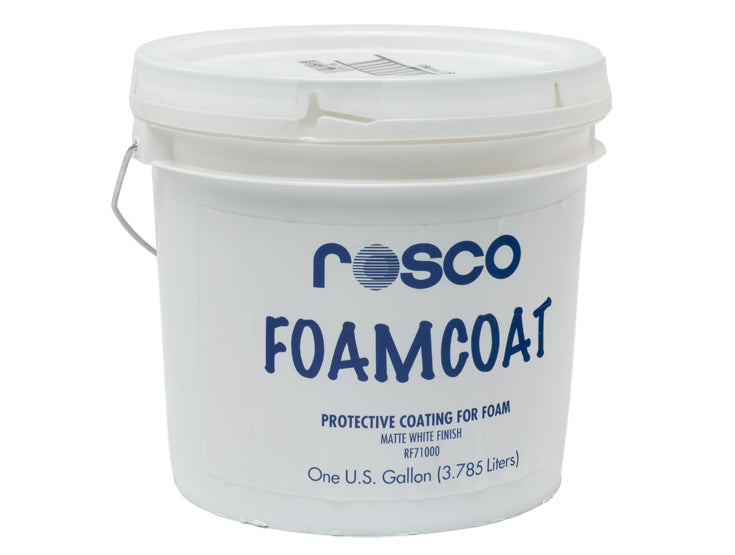

Rosco FoamCoat – Professional Foam Hardener & Protective Coating (7100)
Rosco FoamCoat – Professional Foam Hardener & Protective Coating (7100)
Rosco FoamCoat turns fragile XPS, EPS and polystyrene foam into a tough, impact-resistant, paint-ready surface. It’s the industry go-to for scenic artists, prop builders and fabricators who need foam scenery to survive handling, rehearsals, touring and real-world use.
- Designed for foam: XPS, EPS, polystyrene, “pink foam”
- Water-based & workshop-friendly: non-toxic, easy clean-up
- Durable finish: sandable, carvable, excellent tooth for paint
- Flame-retardant & water-resistant: ideal for many venue builds
Quick check: If your build is rigid foam and you want a hard shell, FoamCoat is almost always the right pick.
Scroll for how much you need, case studies, and a coating selector if you’re comparing options.
Most common FoamCoat projects
- Carved foam rocks, cliffs, caves
- Foam brickwork and architectural facades
- Lightweight props that need to handle frequent use
- Touring scenery that needs a durable paint surface
- Exhibition / museum display elements
- Event builds & retail displays where weight matters
- Foam signage and sculptural pieces
- Seasonal decor (Halloween, themed installations)
Best for
- Rigid foams: XPS / EPS / polystyrene
- Creating a hard, impact-resistant shell
- Surfaces you want to sand, carve and paint
- Scenic builds needing durability + paint adhesion
If you need flexibility or adhesion
FoamCoat cures hard. If your build must bend/compress, needs adhesive reinforcement, or you want clear effects, these may be better:
- FlexCoat → flexible scenic coating (soft props / touring builds)
- FlexBond → adhesive + coating (mixed materials / reinforcement)
- CrystalGel → clear textures (water/ice/glass effects)
How much FoamCoat do I need?
FoamCoat covers approx. 12–16 m² per gallon, depending on foam texture and application thickness. Most scenic builds use 2–3 coats for a durable shell.
Quick formula (ballpark):
Gallons needed ≈ (Area (m²) × Coats) ÷ Coverage (m² per gallon)
| Example surface area | 2 coats | 3 coats | Notes |
|---|---|---|---|
| 5 m² | ~0.7 gal (at 14 m²/gal) | ~1.1 gal | Round up if heavily textured |
| 10 m² | ~1.4 gal | ~2.1 gal | Most common small scenic builds |
| 20 m² | ~2.9 gal | ~4.3 gal | Consider spray/hopper for speed |
| 40 m² | ~5.7 gal | ~8.6 gal | Large walls / multiple pieces |
Tip: If you’re carving deep texture, plan on the lower coverage (12 m²/gal) and round up. If you want help estimating, contact us with the approximate m² and number of coats.
FoamCoat in action (Rosco Spectrum case studies)
A few real examples of FoamCoat workflows and outcomes. Images & projects courtesy of Rosco Spectrum.



For more resources, comparisons and application tips: Rosco Scenic Coatings – Complete Guide
FoamCoat vs FlexCoat vs FlexBond vs CrystalGel
| Product | Best for | Key advantage | When to choose it |
|---|---|---|---|
| FoamCoat | Rigid foam hardening (XPS/EPS/polystyrene) | Hard, durable, paint-ready shell | Rocks, facades, props, scenic builds needing impact resistance |
| FlexCoat | Flexible foam / soft props / touring builds | Tough and flexible (less cracking) | Anything that must bend, compress or take vibration/impact |
| FlexBond | Mixed materials + adhesion + reinforcement | Adhesive + coating in one | Foam-to-fabric, foam-to-wood, strengthening layered builds |
| CrystalGel | Clear textures / water & ice effects | Clear build-up for special finishes | Water, glass, slime, ice textures, translucent scenic effects |
Want the deeper breakdown (when to use each, plus resources): Rosco Scenic Coatings – Complete Guide
▼ How to apply FoamCoat (step-by-step)
- Stir thoroughly: FoamCoat contains heavy solids. Power mixing is recommended.
- Apply to foam: Brush, roll, or spray (hopper gun) depending on your texture and speed needs.
- Build coats: Multiple coats increase strength and impact resistance.
- Dry between coats: Typically 2–8 hours (depends on thickness & conditions).
- Full cure: Allow ~24 hours before sanding, carving, or painting.
- Finish: Paint with Rosco scenic paints (Off Broadway, Supersaturated) or standard acrylics.
Tip: Use undiluted for maximum durability. Light thinning with water is possible for smoother coats, but reduces toughness.
▼ Technical specifications
- Colour: Off-white, matte finish
- Chemistry: Water-based, non-toxic, inherently flame-retardant
- Coverage: approx. 150 sq ft per gallon (roughly 12–16 m²)
- Recommended film thickness: approx. 1/16" – 3/16" per application
- Dry time: approx. 2–8 hours between coats (thickness/environment dependent)
- Full cure: approx. 24 hours before sanding, carving, or top-coating
- Application: Brush, roller, or hopper spray gun
- Clean-up: Soap and water (while wet)
- Shelf life: Minimum 24 months in sealed container (stored properly)
- Compatibility: Rosco scenic paints + most water-based coatings
- Mixing: Stir well; heavy solids can settle (power mixing recommended)
- Dilution: Use undiluted for max durability; thin with water if needed for smoother coats
▼ FoamCoat FAQ
Does FoamCoat melt foam?
No — it’s water-based and designed for EPS/XPS/polystyrene.
Can it be used outdoors?
FoamCoat is water-resistant, but outdoor builds should be finished with paint/top-coat for longer-term weather exposure.
Can FoamCoat be sanded?
Yes — once fully cured, it can be sanded or carved for refined detail.
How many coats should I apply?
Most builds use 2–3 coats depending on durability requirements.
Can I paint it?
Yes — FoamCoat provides excellent tooth for Rosco scenic paints and acrylics once cured.
Which Rosco Coating Do I Need? (Quick Selector)
Most rigid foam builds use FoamCoat. If you’re deciding between coatings, use this simple decision tree:
Start here: What are you trying to achieve?
-
I need a hard shell on rigid foam (XPS/EPS/polystyrene)
✅ Choose: FoamCoat
Best for rocks, facades, props and scenic builds needing impact resistance and a paint-ready surface. -
My piece needs to bend/compress or take impact without cracking
✅ Choose: FlexCoat
Best for soft props, touring sets and flexible foam builds. -
I need a strong adhesive + coating for mixed materials
✅ Choose: FlexBond
Ideal for reinforcement and adhesion across foam + fabric + wood + layered builds. -
I need clear texture build (water/ice/glass effects)
✅ Choose: CrystalGel
Best for translucent scenic textures and special effects finishes.
Want the full coating breakdown + resources? Rosco Scenic Coatings – Complete Guide
Need more than specs?
Explore the complete guide for application tips, outdoor best practices, safety notes and comparisons across FoamCoat, FlexCoat, FlexBond and CrystalGel.
View Rosco Scenic Coatings – Complete GuideNote: Performance depends on substrate, film thickness, curing conditions and finishing system. If your project has specific compliance requirements, contact us for guidance.