
Rosco Opti-Sculpt™ Beam Shaping Lenses
Rosco Beam Shaping Guide

A complete guide to shaping, widening and controlling fixture beams for theatre, architecture, broadcast, film, museums and immersive environments.
Rosco Opti-Sculpt™ lenses help lighting designers and architects solve one of the most common lighting problems: when the beam angle coming out of the fixture is not the beam shape the project actually needs. Instead of simply blurring light like traditional frost, Opti-Sculpt reshapes it into controlled, usable distributions with high transmission and repeatable results.

What is Rosco Opti-Sculpt?
Opti-Sculpt is an engineered light-shaping lens that changes the beam pattern of a fixture into controlled symmetrical or asymmetrical spreads. It is designed to help users get more usable coverage from their existing fixtures while keeping far more punch than conventional diffusion. Rosco and Spectrum case studies repeatedly show it being used where designers need cleaner wall washes, more even uplighting, reduced hotspots and better beam matching across a rig.
That makes it especially useful for lighting designers, consultants, architects, venue teams and production crews who need a practical beam-control tool without changing fixtures, repositioning fittings or losing excessive output. This is one reason Opti-Sculpt appears across museum lighting, holiday trails, studio lighting and architectural uplighting projects.
Why designers use it
To widen narrow beams, reduce hotspots, stretch light vertically or horizontally, blend multi-source LEDs and better match fixture output across a system.
Who it suits
Lighting designers, architects, broadcast studios, museums, venues, integrators, consultants, event teams and specifiers wanting more precise beam control.
Where it works best
Wall washing, uplighting, scenic lighting, exhibition lighting, studio set lighting, immersive installations, walkways, trees and feature architecture.
Why Opti-Sculpt is more than just a frost
One of the key ideas repeated across Rosco’s Opti-Sculpt education pieces is that these lenses are not simply diffusers. Traditional frost tends to soften and spread light in a broader, less controlled way. Opti-Sculpt, by contrast, is used when you want the beam to go somewhere specific and behave consistently across a surface or object. That distinction matters in both entertainment and architectural work, where precision often matters more than simply softening the edge.
For architects and lighting designers, that means more control over vertical surfaces, columns, facades, galleries, pathways and scenic elements. For production teams, it means solving beam problems quickly without redesigning the rig.
Common lighting challenges Opti-Sculpt solves
1. Narrow uplights that create hotspots
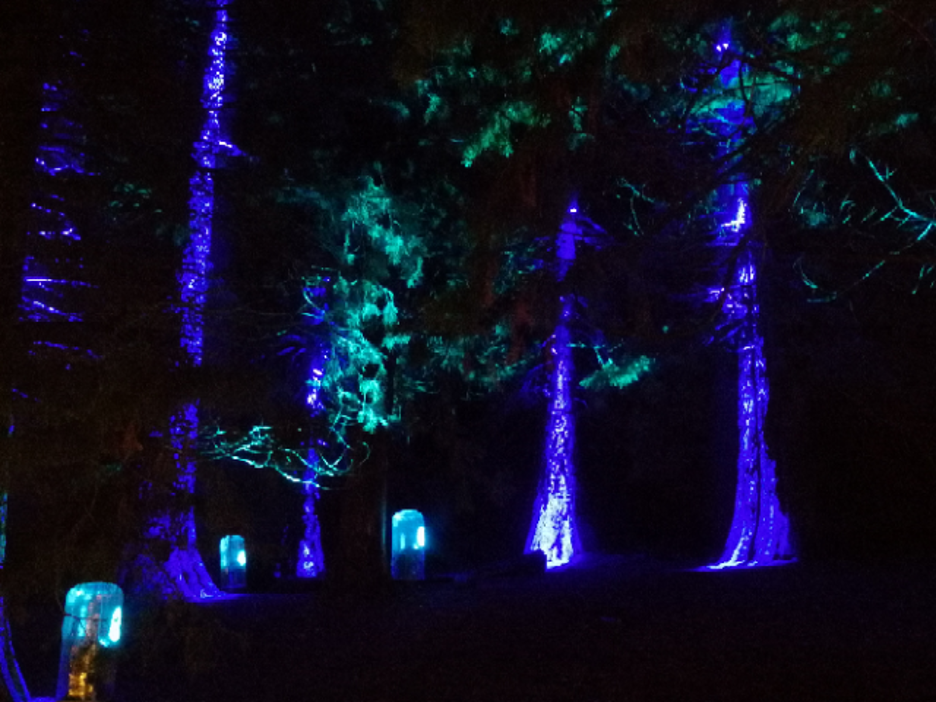
Many compact uplights or LED fixtures produce narrow beams that leave the centre bright and the surrounding surface underlit. Rosco’s holiday trail case study shows how Opti-Sculpt allowed tight beams to be stretched and widened so more of the tree trunk or path could be illuminated with minimal spill and very little light loss.
2. Lighting tall vertical surfaces more evenly
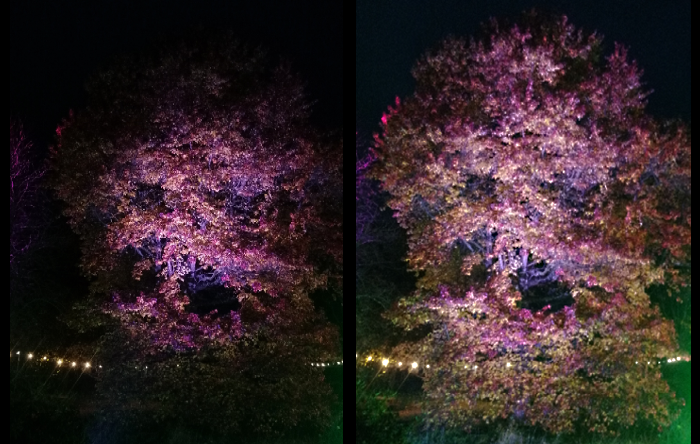
Opti-Sculpt’s asymmetrical patterns can be used to push light vertically without wasting as much light left and right. This is useful for columns, textured walls, display surfaces, scenic flats and tall architectural details where the fixture position is fixed but the required spread is not. Rosco’s examples show how changing to a different Opti-Sculpt pattern can light more of the subject and reduce the hot spot in the centre.
3. Pathway or surface lighting with uneven spread
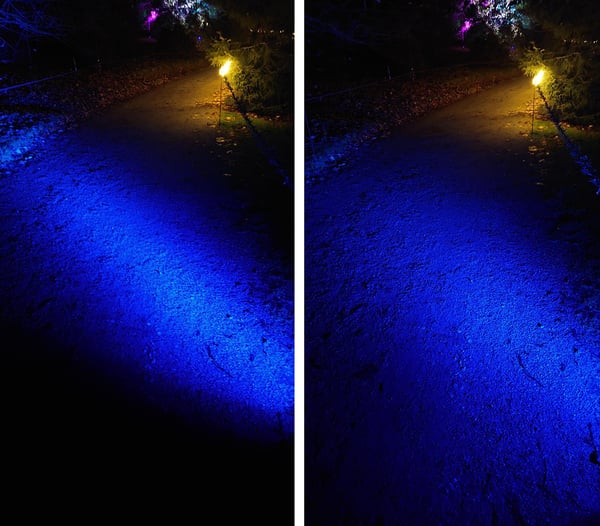
Walkways and floor surfaces can reveal uneven beam structure very quickly. In the holiday trails project, Opti-Sculpt broadened the beam and removed visible hotspots from the pathway, creating more even light with better photographic results for guests. That kind of control is highly relevant for public spaces, attractions, events and landscape lighting.
4. Broadcast and set lighting that needs cleaner scenic coverage
In broadcast environments, uneven fixture spread or poorly shaped background light can read badly on camera. Rosco’s BBC News studio case study shows how Opti-Sculpt was used as part of a flexible lighting solution to help shape beams across scenic elements and improve consistency on set. That same principle applies to studios, houses of worship, black box spaces and other controlled environments where lighting must read cleanly to both camera and eye.
Real projects using Opti-Sculpt


Available Opti-Sculpt beam patterns
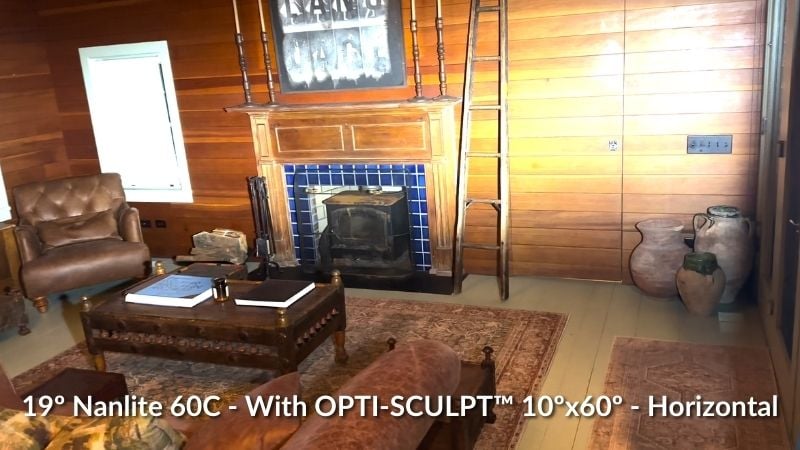
Rosco’s holiday trail article notes that Opti-Sculpt is available in eleven different patterns, giving designers options for both circular and linear beam shaping depending on the application.

10° • 20° • 30° • 10° × 20° • 10° × 30° • 10° × 40° • 10° × 60° • 15° × 35° • 15° × 45° • 20° × 40° • 40° / 60° reversible

The 11-piece design kit is one of the best ways to test Opti-Sculpt
If you are exploring Opti-Sculpt for the first time, the Rosco Opti-Sculpt 11-Piece Design Kit is a very practical starting point. It lets you compare the different beam patterns directly with your own fixtures, throw distances and surfaces before committing to larger quantities.
For lighting designers, consultants and architects, that makes the design kit a useful evaluation tool during concept development, mock-ups, commissioning and on-site testing.
Read more on Rosco Spectrum
These Rosco Spectrum articles are worth reviewing if you want deeper examples of how Opti-Sculpt performs in the field.
Opti-Sculpt for Australia & New Zealand
CFATS supplies Rosco Opti-Sculpt throughout Australia and New Zealand and can help with beam pattern selection, product supply and practical advice for theatre, architecture, exhibition lighting, broadcast, film and event applications.
If you are trying to solve a real beam problem rather than just buy a sheet, send us the fixture model, throw distance and what you are trying to light. We can help narrow down the most suitable Opti-Sculpt option.
Request an Opti-Sculpt sample / swatchbook
Want to test beam shapes before specifying a project? Use the form below to request an Opti-Sculpt sample, swatchbook or advice on the best way to evaluate the range. The 11-piece design kit is also a great option if you want to test multiple patterns properly.